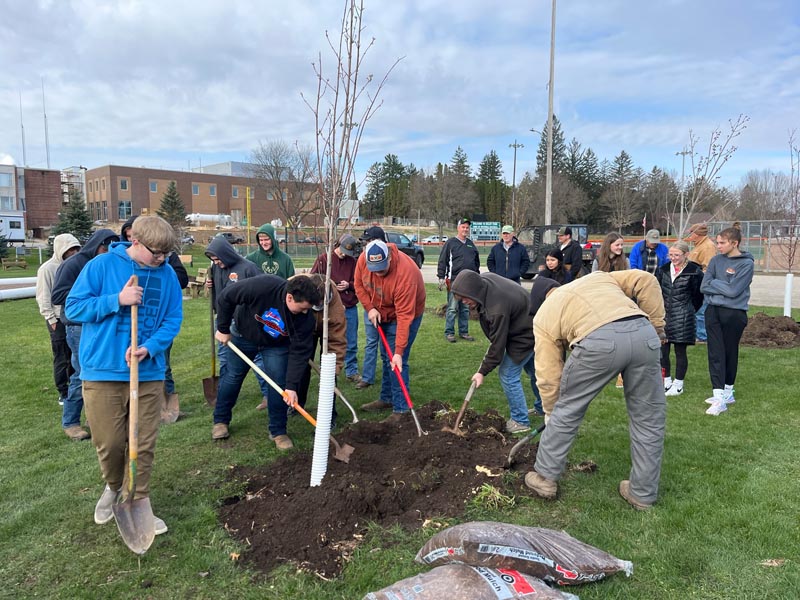
The Ground Tells a Story
Before any hole is dug, the site already has a history. Soil that has been compacted by construction, areas that hold water longer than others, or patches where grass struggles to grow all offer clues. A landscaping contractor may arrive with a plan, but the land often asks for adjustments.
In parts of Wisconsin, Minnesota, and Iowa, this becomes especially important. Freeze and thaw cycles can leave soil dense in spring, while late summer may bring dry, hardened ground. Ignoring these patterns can set a tree up for a slow struggle rather than steady growth.
Taking time to read the ground is not extra work. It is the beginning of proper tree planting.
Depth Is Not a Guess
One of the most common mistakes happens before the tree is even placed. Tree planting depth is often treated as a rough estimate, but a few inches too deep can have lasting consequences.
The root flare, where the trunk widens at the base, should sit just above the surrounding soil. When buried, the tree can develop issues that are not immediately visible. Leaves may look healthy for a few seasons, but below the surface, roots can begin to circle or press against the trunk.
Planting slightly high is often safer than planting too deep, especially in heavier Midwestern soils that settle over time.
Roots Need Space, Not Correction Later
It is tempting to think that any root issue can be fixed down the road. In reality, early conditions shape how roots behave for decades.
Stem girdling roots are a good example. When roots circle too tightly around the trunk, they can restrict growth and water movement. This often begins in the nursery stage or from being planted in a confined space.
Some growers now use air-root pruning technology to reduce this problem before the tree ever leaves the nursery. While this does not eliminate all risk, it can lead to a more outward-growing root system that adapts better once planted.
Still, even a well-grown tree can develop issues if planted incorrectly. Loosening the root ball and correcting circling roots at planting is a small step that can prevent long-term stress.
Pruning Starts Earlier Than People Think
Many assume pruning begins years after planting, but early decisions matter. Stewardship pruning focuses on guiding structure rather than removing large sections later.
In the first few seasons, this might mean removing competing leaders or lightly shaping the canopy to encourage balanced growth. It is less about appearance and more about reducing future problems.
Trees planted in open residential areas across Iowa or suburban neighborhoods in Minnesota often face different wind and light conditions than those in wooded settings. Early pruning helps them adapt to those conditions gradually.
Expectations Shape Outcomes
There is a quiet misunderstanding around timelines. Some people expect immediate shade or rapid growth, especially after investing in a new tree. Others assume that once planted, the tree will manage on its own.
The reality sits somewhere in between. Establishment takes time, and early care plays a large role in how well a tree settles in.
Watering practices, mulch placement, and monitoring for stress are all part of the process. While some providers mention a 5-year warranty, the real measure of success often comes from consistent attention in those first few seasons.
Regional Differences Matter More Than You Think
Though Wisconsin, Minnesota, and Iowa share many similarities, subtle differences can influence outcomes.
Northern areas may deal with longer winters and shorter growing seasons. Southern parts of Iowa might see more heat stress during summer months. Soil composition can vary even within a single property.
Recognizing these differences helps guide decisions about species selection, planting timing, and aftercare. What works well in one yard may need adjustment just a few miles away.
A Thoughtful Start Carries Forward
Planting a tree is often seen as a single event, but it is better understood as the beginning of a long process. Each step, from evaluating the soil to setting the correct depth, contributes to how the tree will grow over time.
There is no single technique that guarantees success. Instead, careful attention to small details builds a stronger foundation.
The first shovel may mark the start, but what happens before and immediately after matters just as much.