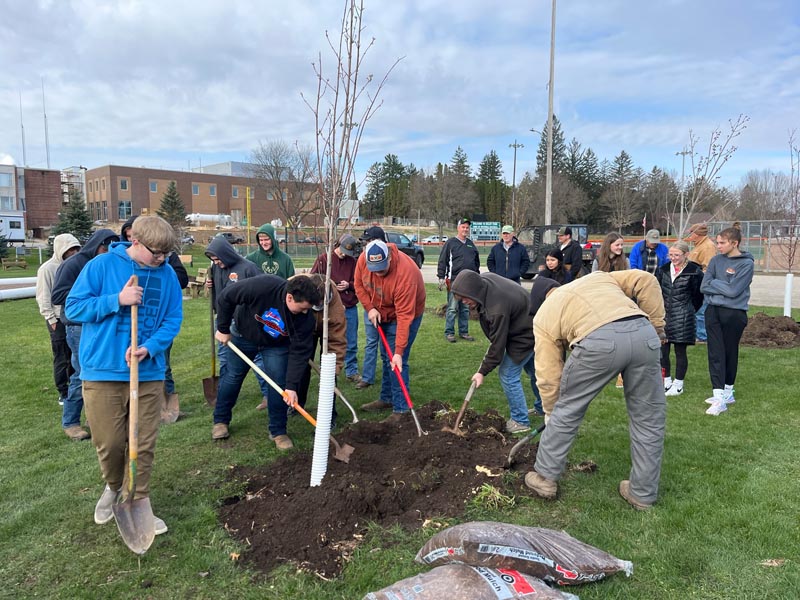
The Quiet Work After Planting
Planting day tends to get all the attention. There is a hole, a tree, and a sense that the job is done once the soil is tamped and watered. In reality, the first five years are when most of the important work happens, and much of it is easy to overlook. A landscaping contractor might install a tree correctly, but the conditions that follow will determine whether that tree settles in or struggles.
Across Wisconsin, Minnesota, and Iowa, young trees face a mix of heavy soils, seasonal swings, and periods of both excess moisture and drought. These factors make early care less about quick fixes and more about steady, informed decisions over time.
Why Depth Still Matters Months Later
People often hear about proper tree planting on day one, especially the importance of tree planting depth. What is less discussed is how that depth continues to affect the tree months and even years later.
If a tree is planted too deep, it may not show immediate stress. Instead, growth can slow gradually. Leaves may appear smaller, or the canopy may thin without an obvious cause. Over time, buried root flares can contribute to stem girdling roots, which restrict the flow of water and nutrients.
Even when planting is done correctly, soil can settle. Mulch can accumulate. Both can unintentionally raise the grade around the trunk. Keeping the root flare visible is not a one-time task. It is something to check each season.
The Early Signs People Miss
In the Upper Midwest, many tree issues are blamed on weather. Harsh winters and humid summers are easy explanations. But some of the most common problems begin at the root level and develop quietly.
A tree that leafs out later than others of the same species may be dealing with root stress. A slight lean can indicate instability below ground. Even a tree that looks healthy from a distance can have early root circling that will become more serious over time.
These are not dramatic failures. They are small signals that something is off.
Root Development and Container Choices
The way a tree is grown before it is planted has a lasting impact. Traditional containers can encourage roots to circle along the edge, which increases the risk of future girdling. Newer approaches, including air-root pruning technology, aim to guide roots outward and reduce that pattern.
This difference is not always visible at planting. It becomes more apparent as the tree establishes itself. A well-structured root system supports stronger anchorage and more consistent growth, especially in areas with clay-heavy soils like parts of southern Wisconsin and eastern Iowa.
Pruning as Guidance, Not Correction
Pruning is often thought of as something that happens after problems appear. In the early years, it serves a different purpose.
Stewardship pruning focuses on guiding structure while the tree is still flexible. This can mean selecting a central leader, spacing major branches, and removing competing growth before it becomes an issue. Done thoughtfully, it reduces the need for heavier cuts later in the tree’s life.
In regions like Minnesota, where snow and ice can put stress on branch structure, early pruning decisions can influence how well a tree handles those conditions.
Watering Patterns Over Time
Watering advice is often simplified to a schedule, but young trees do not follow a calendar. They respond to soil conditions.
In a wet spring, additional watering may not be needed at all. In a dry stretch during late summer, even established trees can benefit from supplemental water. The key is consistency without overcorrection.
Too much water can be just as limiting as too little, especially in compacted soils where drainage is slow. Observing how quickly the soil dries and adjusting accordingly is more useful than sticking to a fixed routine.
Understanding the Long View
Some nurseries and growers reference a 5-year warranty as a general benchmark for establishment. Whether or not that applies in a specific situation, the timeframe itself is meaningful. It reflects how long it can take for a tree to fully adapt to its new environment.
During those years, growth may not always be steady or predictable. A tree might focus on root development one season and canopy expansion the next. Patience is part of the process.
The goal is not rapid growth, but stable growth.
Small Adjustments, Lasting Impact
Many of the most effective actions in the first five years are simple. Adjusting mulch to keep it away from the trunk. Checking that the tree has not settled too deep. Watching for early signs of girdling roots. Making light pruning cuts at the right time.
None of these steps are complicated, but together they shape how a tree matures.
In landscapes across Wisconsin, Minnesota, and Iowa, where conditions can vary widely from one site to another, these small adjustments often make the difference between a tree that merely survives and one that develops into a lasting part of the landscape.